

© 2021 FRAN ESCRIBÁ All Rights Reserved Realizada por Jm2informática

20/12/2016
Villarreal liberated under Fran Escribá as Yellow Submarine enjoys calmer waters
Escribá’s appointment was a shock on the eve of the season but Villarreal have moved serenely into fourth place with a more relaxed approach
Fran Escribá was wearing swimming trunks and was on his way down to get an ice cream when the phone rang. It was 10 August, half past 11 at night, by the beach in Puig and he had missed a couple of calls already. He was on holiday after all, a football manager out of a job and pretty sure he wasn’t going to be in one any moment now: it was too late to start a season and too soon to save one. This time he recognised the number and picked up. “Hey,” he was told, “Fernando Roig is trying to get hold of you.” Fernando Roig is the president of Villarreal and he’d just done something unexpected, eight days before it all began. Unexpected to everyone on the outside, at least.
“They’ve sacked Marcelino.”
“What are you on about?”
Escribá took off his trunks, put on some trousers, jumped in the car, and set off to meet Roig for a coffee. Fortunately, he wasn’t far away. By midnight, he was there; by the following night, he was their new manager. “You can’t say no to Villarreal,” he said at his presentation. A stable, financially secure club where Manuel Pellegrini lasted five years and Marcelino García Toral four; where there’s little pressure, the set-up is superb; and the ‘ecosystem’ so secure even relegation didn’t sink them; a club with a strong squad that achieved three consecutive top-six finishes and had the Champions League to look forward to. No, you can’t say “no” to that.
Nor, though, do you just say yes straight away, without thinking. From the outside, no one knew there was a problem, but Villarreal had just sacked their manager – and you don’t do that for the fun of it. Escribá wanted to know what had happened, what he might find. There could be a disaster lying in wait. One thing was for sure: this was not as simple as it looked.
In the wake of his sacking, Marcelino again insisted on his professionalism and honesty, holding a press conference and defending himself from the crass accusation of the Rayo president Martín Presas who’d likened him to the Lufthansa pilot that crashed his plane into the mountains (an accusation he then blamed on the media), threatening legal action and insisting: “I’m neither mad nor an assassin.” But Roig publicly insisted he had sacked his manager on principle; it was, he said, a question of “honour”. That referred to the final day last season when Marcelino was accused of not trying to beat Sporting Gijón, his local team and the one he grew up at, played for, managed and supports; that day, Villarreal lost, Rayo and Getafe were relegated, Sporting survived and Marcelino’s wife posted: “I leave Asturias, job done. We leave you in primera.”
That, though, had been almost three months earlier, and there indeed was more to it. Marcelino’s relationship with the board had been strained for a while, even more so with the club’s patriarchal president, and there had been tension over the summer signings. His relationship with the squad was worse still. Everyone agreed he was a superb manager but he was hard to live with, imposing to the point of invasion, and for some the tension had become unbearable. A confrontation with Mateo Musacchio brought things to a head. According to reports, an ultimatum was put to the board: “Him or me.” The board chose him. And so, on the eve of a new, exciting season, Villarreal sacked their manager. No one could understand it. Asked if he had a message for the fans, Roig replied: “Trust in us: your president isn’t completely stupid.”
They trusted him – how could they not? – but he had just sacked the manager who had brought them up from the second division, taken them into Europe twice, reached a Copa del Rey semi-final, a Europa League semi-final too, and then clinched a Champions League place. Escribá knew that he wasn’t just competing against other teams; he was competing against the club’s recent history and their former manager too. The expectations were high; higher than they had been for years. Some even suggested that this was the best squad they’d had; that was an exaggeration but it was understandable. Fail to win and Marcelino’s name would be one he would hear a lot of. His own ‘surname’ would become vete ya: Fran Go Now!
He had less than a week before their Champions League qualifier against Monaco. He met with the club captains and told them that he had to know in six days what he would usually find out in six weeks, or more. Had he arrived in July, it wouldn’t be necessary; but it was August now. They hardly knew him; he was at their mercy. He had to trust them. But what they told him fitted with what the president had said. What he found, he admits, was players who were “stressed”, a dressing room where there was “a lot of tension”. Marcelino had been such a perfectionist, so obsessive as to be occasionally counter-productive. Samu Castillejo summed it up when he expressed his relief at no longer being shouted at. Staff had seen players so desperate not to miss ultra-strict weight targets that they arrived dehydrated.
Escribá also found things that he liked, though, better even than he had imagined; good, intelligent players, an environment that would help. It’s often said that Villarreal’s results go under the radar; it’s more that they live under the radar. There’s a tranquillity and familiarity about the training ground, an old orange grove where the smell of kit in the washing machines drifts across the main pitch, where the youth teams train too and the space is shared, where the facilities are among the best in Spain, from the playing surfaces to the gym to the medical centre; the staff too. If the tension could be reduced anywhere, it is here, and that was his first task: to recover them emotionally, psychologically, seek normality. In his words to “see them smile again”.
“Football is not everything in football,” he says.
If the results came, things would be OK, he thought. But they didn’t, not at first. When he arrived Villarreal had eight players injured, including their two first-choice strikers and the captain, Bruno. It had just been confirmed that Roberto Soldado’s season was virtually over before it had begun. With 12 players available, a youth team player making up the numbers, they lost 2-1 at home to Monaco. It took a season to earn a Champions League place, one night to effectively lose it. There would be no comeback in the second leg, no money for the club. One paper called it a “hecatomb”. There were no wins in the league, either. They drew 1-1 at Granada and 0-0 against Sevilla. They went into that first international break – a first opportunity to pause, think, prepare – with just two points.
Three months on, Villarreal go into the Christmas break with 29 points and back in a Champions League place. They’re also through to the next round of the Europa League. That international break was followed by a seven-game unbeaten run, taking them to nine in total, before a defeat at Eibar. Only Madrid lasted as long – they’re still going – and Villarreal drew at the Bernabéu, beat Real Sociedad, Málaga and Las Palmas. They put five past Celta. Soon, Bruno was admitting that they had been released; the sensations had shifted, things were getting a little better. Put simply, they were happier, more comfortable.
On the pitch, there was a shift too. There was no revolution, but there was an evolution; building on Marcelino’s work, not throwing it out. He was not a manager who was sacked because he failed – far from it. No one has conceded fewer goals, and that defensive solidity comes from the Marcelino era and beyond: three of the typical back four – Mario, Muscacchio, Jaume Costa – are youth-team products who’ve played together for eight years. They’re still quick, usually incisive on the break. But the drills implicitly encourage them to break a little from counter-attacking and to have the ball more, to keep the opposition further away. “Bruno is always Bruno,” one member of the coaching staff says. Alongside him, Trigueros has been superb. Sansone and Soriano, two Italians in Spain who speak German together, have proven impressive signings. Sergio Asenjo has made it to the Spain squad.
It hasn’t always been perfect; there have been doubts, uncertainties, but it is working. Progress in Europe was not smooth; in fact, they were on edge. Defeat at Eibar was followed by a win against Betis but then they lost at Athletic, lost at Alavés, drew with Leganés. Four points from 15, just three goals; three games in a row without scoring. Bakambu, given few opportunities, hasn’t produced last year’s form without Soldado, while Pato has been a little erratic. After the 0-0 with Leganés, Jaume Costa hinted at flaws, perhaps even the need for more tension, insisting: “I don’t think I should say what I think’s going wrong: it’s not good to speak while you’re still ‘overheated’. We have to think, analyse, and talk. That’s something we’re finding hard to do in the dressing room.” One newspaper saw the “shadow of Marcelino” cast over Escribá once more.
But then last Monday Villarreal thumped Atlético Madrid 3-0 – yes, Atlético; yes, three. Then this weekend they returned to Gijón, back where all the mess began, the origins of a phone call to Escribá late one night in August, and this time there were no doubts, even if some of the interest was third-party again, or simply non-existent: while AS’s match report was pathetically small and El País’s didn’t exist, Super Deporte, Villarreal’s most local sports newspaper, really, really cared for once – although that was not because they could go into Christmas in a Champions League place with a win so much as because if they did so Valencia would not go into Christmas in a relegation place.
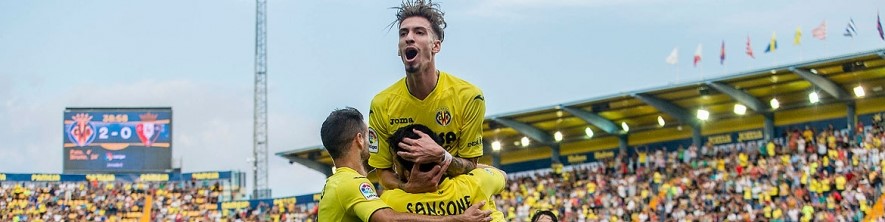
Which was exactly what happened, the Yellow Submarine winning their first away game in La Liga in three months. Villarreal dominated, Dos Santos scored for the second game running, Sansone got another, Bruno and Trigueros controlled, and Pato was spectacular, handed a standing ovation at the end – by the Sporting fans.
“It’s not a case of the team just turning it on or off; sometimes things work,” Escribá said. “We saw against Atlético that one of the keys is that the team felt liberated from the pressure of [qualifying in] Europe.” One of the keys is that it felt liberated from the pressure, full stop. “And now?”, he was asked. “Now: rest, sleep well, train Monday, and on Wednesday they can forget about me for a few days. This is the level we have to be at if we are going to be where we want to be.” From ice cream in August to the Champions League at Christmas.
Artículo publicado por Sid Low para The Guardian el 19 de diciembre de 2016.
Últimas Apariciones
20/12/2016
20/12/2016
18/11/2016
26/10/2016
26/10/2016
19/09/2016
22/10/2015
22/10/2015
21/09/2015
28/08/2015